EN
EN  PT
PT ES
ES FR
FR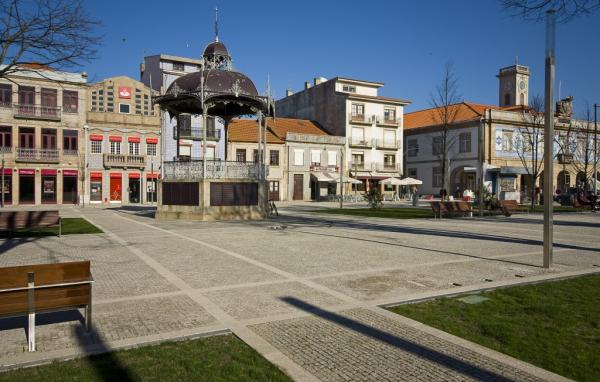
Itinerário - Conhecer a Póvoa de Varzim
The medieval town had its pole in a slightly inland area and from there it expanded to the west, towards the beach. In the 16th century, an urban center developed in the area that today corresponds to the immediate vicinity of the Matriz, and which became the municipal center of a village in full progress.
.
Póvoa de Varzim
Description
* Duration: Average time - 1h30
* Distance: 2.7 kms
Departure point: Tourist office
Leaving the Tourist Office, turn left and go through the access gate to Praça Marquês de Pombal. Here, take the opportunity to admire an original sculpture, by Margarida Santos, in honor of a great mayor of this city, Dr. David Alves, who was largely responsible for the bathing feature of Póvoa de Varzim.
Go now to the Municipal Market, where you can find a privileged world of women, both as a seller and as a buyer. In the middle of a showcase of fish and a sea of colors of fruits and vegetables, the woman, fishmonger, farmer or city, gives them the human touch, often loaded with ethnographic meaning.
Arriving at the traffic lights, turn right, on Av. Mouzinho de Albuquerque, towards Largo das Dores, where important public services are concentrated, such as the Hospital and the Palace of Justice. First, however, take a look north along Rua Conselheiro Abel Andrade, where you'll find the Eça de Queirós Secondary School. In that block, are concentrated establishments of all levels of education and, as if to crown this area of learning and knowledge, the Municipal Library is also installed here. This building results in a happy and harmonious combination of traditional and modern architecture. Of the construction set, the worked granite façade of the old Orfeão Povoense stands out, which contrasts with the light and glazed structure of the building's body. Next to the Library, notice the statue of Rocha Peixoto, by the sculptor Hélder de Carvalho
Returning to Largo Das Dores, it is necessary to notice better its architectural ensemble, where two temples stand out: the Misericórdia and the Senhora das Dores. The church of mercy, located to the west of the hospital, fits in a wide space that makes its frontage even more prominent, where the collage of architectural volumes of different styles (neo-classical below and baroque above) give it great originality. . Conceived by Adães Bermudes, it was blessed on August 12, 1914. The source of the square is Igreja Da Senhora Das Dores. Pentagonal and baroque in style, it dates from the end of the 18th century, although it was not until 1866 that it acquired its current appearance with the completion of the 6 small surrounding chapels. Represented by natural-sized sculptures, six of Our Lady's pains are illustrated here, the seventh being on the main altar itself. It has a manual chime of 16 bronze bells.
After visiting the Dores church, follow the street to the south. Here we come across a garden space where a wrought iron fountain rests.
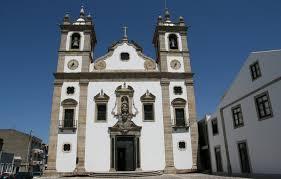
Continuing straight, turn left, on Rua da Moita and you will quickly find yourself on Rua de S. Pedro, where you should turn right, towards the Igreja Matriz. Opened in 1757, this is the oldest and most significant temple in the city. With a Baroque style, its interior is filled with beautiful gilded «Rocaille» altars and beautiful and unexpected decorative details, such as the presence of mermaids in holy water sinks.
In the area surrounding the church, there are some buildings that are several hundred years old. On Rua da Igreja, to the left of the Church, notice a manor with a chapel and on the corners in front of the temple, two others, the one on the right side being the headquarters of the First Paços Do Concelho. This single-story construction dates from the 16th century, with the appearance of a stately home, and which rests on 5 arches. On its facade, between its only windows, above the central arch, a Stone of Arms stood out. The side entrance is via an exterior staircase with a solid stone fence. Built in the civic center of the village at the time, this is one of the symbols of the autonomy that the village was achieving and which, in the 16th century, had a high moment.
Now turn right, along Rua da Igreja and observe the various streets that come into it. It is the opportunity to visit some Traditional Streets. These narrow, clean and simple alleys form a pleasant picture that the traditional lanterns reinforce. At the beginning of Rua do Visconde de Azevedo you will find the Municipal Archive, formerly «Casa dos Limas», the source and the Municipal Museum of Ethnography and History, to the west. This emblazoned building from the second half of the 18th century, known as Solar dos Carneiros, has undergone, over the years, several changes in structure and detail. Founded in 1937 by the ethnographer Poveiro António dos Santos Graça, it is a Museum with great ethnographic value, having an important collection on the original fishing class of the people.
Go down Rua Visconde de Azevedo. Once again, notice the threading of the streets that flow there. You will find Largo Eça de Queiroz, framed by the house where the writer was born, a simple cruise and a two-fountain fountain, built in 1855 and covered in 1955, with a tile panel representing the biblical passage of «Samaritan desedentando Cristo».
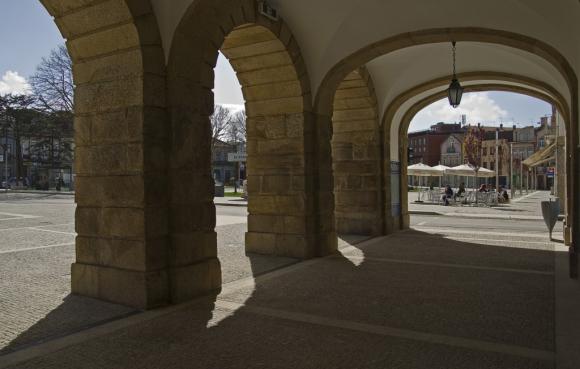
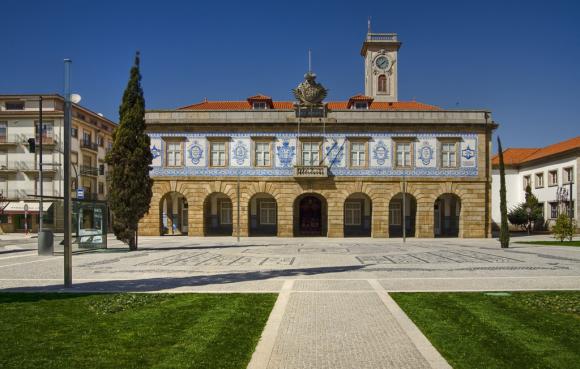
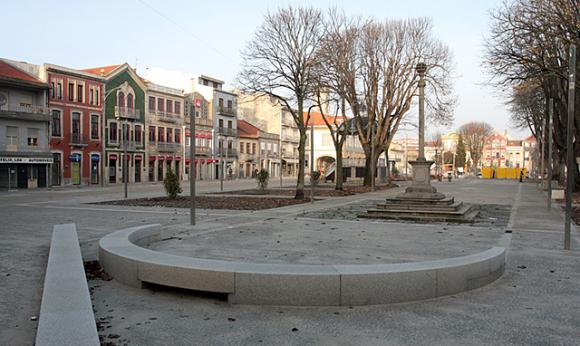
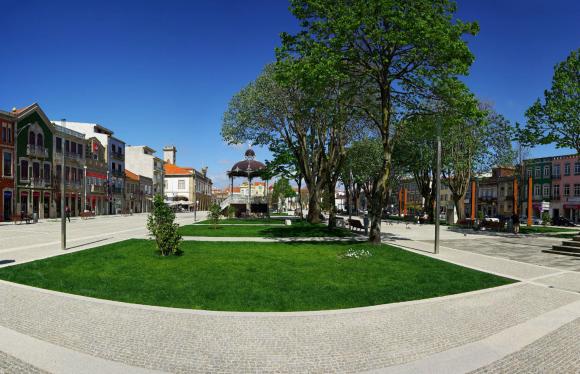
Going down a little further, you will find yourself at the eastern top of Praça Do Almada, a civic center and a true “living room” of the city. Remodeled in 2007, an interesting architectural ensemble surrounds it and the main symbols of yesterday's and today's municipal autonomy are concentrated, as is the case of Paços Do Concelho. The front archway, designed in 1790/91 by the French engineer Reinaldo Oudinot, suggests the architectural and decorative structure of Feitoria Inglesa do Porto. It was inaugurated on December 28, 1807. Between 1908/10 it underwent extensive works of expansion and decoration guided by the ethnologist Rocha Peixoto and the Belgian painter Joseph Bialman: tower and interior and exterior tile of the building.
Still on the east side of the square, the A Eça De Queiroz Monument. The great writer was born in this city on 25 November 1845, in Praça do Almada, in a house marked by a bronze plaque by Teixeira Lopes alluding to the event. The monument by the sculptor Leopoldo de Almeida was erected in 1952, under the subscription of the people of Brazil.
At the west top of Praça do Almada you will find Pelourinho. It consists of a stone column, resting on steps, with the armillary sphere at the top of the shaft, an emblem of King D. Manuel I that gave autonomy to Povoa de Varzim in 1514, being the only piece of the primitive pillory erected that year and rebuilt in 1854.
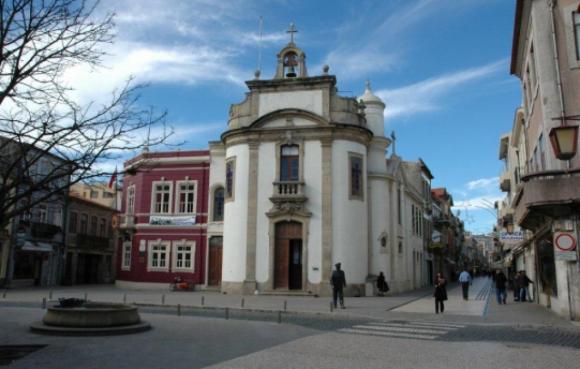
Now follow R. Dr. Sousa Campos and Praça da República, until you find the Capela de s. Tiago. This temple has its origins in an earlier one that has existed there since the 16th century, in honor of S. Roque. However, the growth of the cult of S. Tiago justified the change in the invocation and the construction of a larger temple - the current one, dating from the end of the 19th century.
On the right side of the chapel is the entrance to Rua da Junqueira, an artery that connects the city center to the beach. Notice the statue dedicated to a notable mayor of the municipality, Major Mota, by the sculptor Margarida Santos.
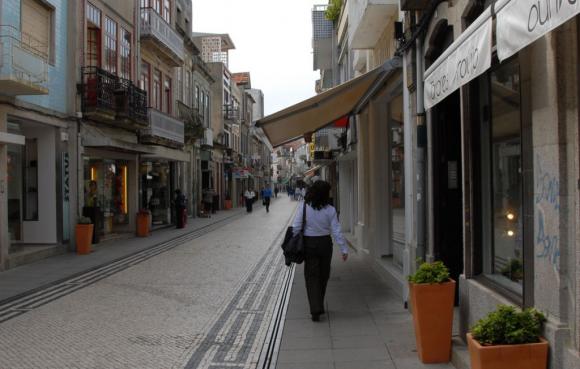
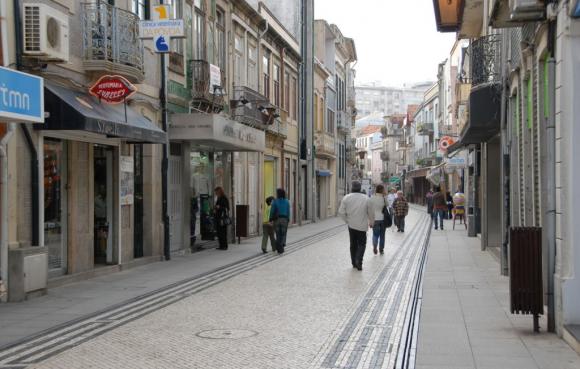
Rua Da Junqueira, pedestrian since 1955, has a fundamental role in the urban fabric. With a strong sense of meeting place and excellent commercial vitality, it is rich in 19th century and early 20th century buildings. As in Praça do Almada, these buildings usually suggest a simple typology of commercial ground floor and two floors, with emphasis on the use of highly aesthetic materials, such as granite in marking the structure of the building. facade and very diversified tiles. In addition to this wealth of elevation composition, there are also beautiful wrought iron balconies. At Largo Dr. David Alves, and heading towards the sea, we should mention the building of Residencial L. B., the oldest hotel in operation. Here the great romantic writer Camilo Castelo Branco was installed, during his stays in Póvoa.
You can return to the Tourist Office by crossing Rua da Junqueira in the opposite direction, taking the opportunity to do some shopping in the countless traditional shops located there.
Source: https://www.cm-pvarzim.pt/
Comments
There are no comments!
Partners same locality