EN
EN  PT
PT ES
ES FR
FR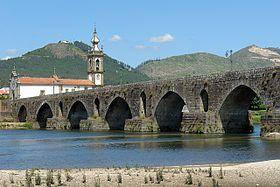
Ponte Romana de Ponte de Lima
The ex-libris of Ponte de Lima, which together with the river that bathes the village, gave the town its name, is its bridge. In reality, it is a set made up of two bridges: a larger, medieval section, which starts on the left bank and extends to the Church of Santo António da Torre Velha and passes through it in two arches. Then, the remaining section of the Roman bridge. There are only five arches from the large arch that is on a dry bed. If you go down you will also see the foundations of Torre Velha, perhaps the first of the medieval defensive system.
Ponte Romana
Ponte de Lima
Description
The Roman bridge probably dates from the 1st century, since it was at that time that the path of one of the military routes of the old "Conventus Bracaraugustanus", which connected Braga to Astorga, in this case Via XIX, was ordered to be opened by the Emperor Augusto.
Regarding the medieval part, in spite of being able to go back in time, at least until the reigns of D. Pedro I and D. Fernando, by direct connection to the construction of the walls and towers that fortified the village, a work completed in 1370 , or even D. Dinis, taking into account documentation referring to a bridge, which could also, by that time, be made of wood, we know of its existence in the reign of D. Manuel I, more precisely in 1504, because this monarch had ordered new paving and put merlons to decorate the bridge, as they were no longer justified as a defensive and military option.
Source: https://www.visitepontedelima.pt/
Comments
There are no comments!
Partners same locality